The Humpback Whale
- Class: Mammalia
- Order: Cetacea
- SubOrder: Mysticeti (Baleen Whales)
- Family: Balaenopteridae (Rorquals)
- Species: Megaptera novaeangliae
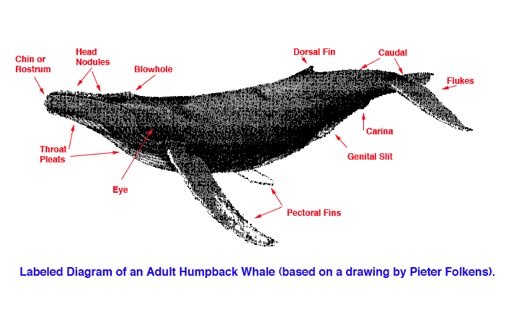
Characteristics of the North Pacific Humpback Whale
Size
- Northern Hemisphere: Adults 45-45 feet
- Southern Hemisphere: Adults approximately 50 feet
- Calves: roughly 12-16 feet at birth
- Record: Southern Hemisphere Female 63 feet
- Females are slightly larger than males, circa 3 feet
Weight
- Adults are approximately one ton per foot in length
- Calves approximately 1.5 tons
Gestation: Estimated to be approximately one year.
Migratory Species
- Summers: Spent in northern latitudes where they feed on small schooling fish and krill.
- Winters: Spent in southern, sub-tropical waters where they give birth and are assumed to mate, though mating has never been documented.
Determining the Gender of Humpback Whales
Physical Differences
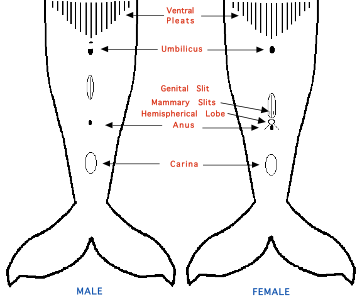
Both genders have internal sex organs. The male's genital slit is located mid-way between the anus and the umbilical. The female's genital slit is located in front of the anus, separated by an anatomical feature known as a hemispherical lobe. The presence or absence of this lobe is used for gender determination in the field.


Behavioral or Contextual Determinations
Females: On the winter grounds, it is extremely rare to find two females in a group/pod. A whale positioned toward the front of a competitive group and appears to be the focal point of the behavior of the other whales in the group is generally thought to be the suspected female. A solitary adult accompanying a calf is generally assumed to be a female.
Males: On the winter grounds, singers are assumed to be males. Whales involved in agonistic, competitive exchanges such as directed lunges, fluke swipes, ramming behavior, etc. are assumed to be males.
Gender roles are not particularly associated with behavior or behavioral contexts on the summer, feeding grounds.
Other Indicators
Body scars are helpful indicators of gender in that males tend to be more scarred than females, but one has to be very careful with this subjective method. There are many ways for females to acquire scars. However, raw chins, head nodules, raw or worn, dorsal fins, anterior edges to flukes and pectoral fins, etc. are associated with sexually mature males.